Profit before tax rose to GH¢118.3 million, customer deposits reached GH¢1.55 billion, NPL ratio improved to 8.1% and cost-to-income ratio fell to 35% for the six months ended June 2026, confirming that the record performance of 2025 has been sustained into 2026 and reflects the new operating level of the business.
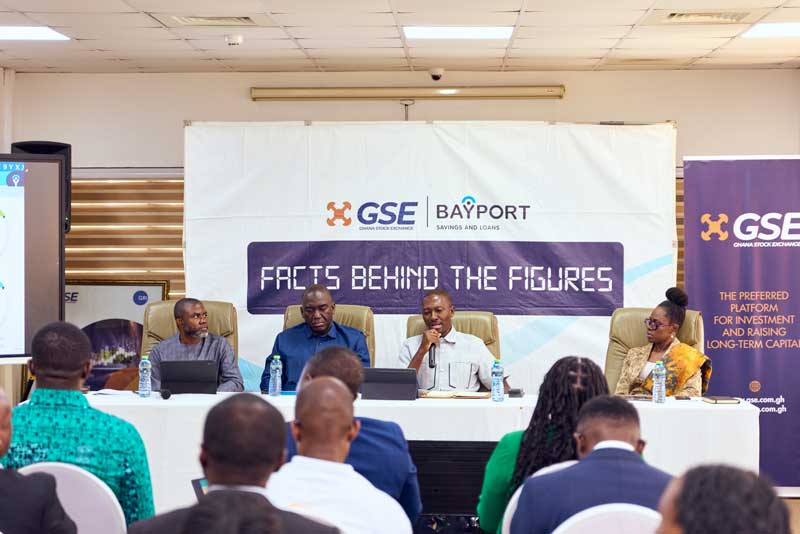
Accra, Ghana – August 2026 – Bayport Savings and Loans PLC presented its half-year 2026 performance to investors and analysts at the Ghana Stock Exchange’s “Facts Behind the Figures” session, reporting profit for the six months to 30 June 2026 that already exceeds the company’s full-year 2025 result.
Profit before tax rose to GH¢118.3 million, from GH¢38.6 million in H1 2025. Profit after tax increased from GH¢26.5 million to GH¢82.5 million, above the GH¢72.1 million reported for the full 2025 financial year.
Total assets grew 77% to GH¢2.44 billion, customer deposits rose from GH¢471.6 million to GH¢1.55 billion, and net loans and advances increased 68% to GH¢1.87 billion.
2025 was a record year, with profit before tax of GH¢103.1 million, nearly three times the 2024 level. The H1 2026 results were delivered on the same funding model, credit discipline and cost structure. They indicate that 2025 was not an isolated outcome but the base level from which the business now operates.
Commenting on the performance, Akwasi Aboagye, Chief Executive Officer, said:
“2025 was an exceptional year, and the natural question was whether it could be repeated. The first half of 2026 answers that question. This is the new performance level of the business, and it confirms that the deposit-led model we have built is the right one and a sustainable one. We have grown responsibly, broadened our deposit base, improved credit quality and used technology to strengthen customer service and control, while managing the effects of payroll clean-up exercises in our core market.”
Deposit-led funding
Bayport historically funded growth through wholesale borrowings, with uncertain timing and no guarantee of success. Over several years, the company invested in deposit products, service centres, onboarding tools and institutional partnerships.
Customer deposits now represent approximately 78% of the funding base, up from 31% in June 2024, and have grown 3.3 times over the past twelve months. Wholesale debt fell by a third over the same period.
The shift has strengthened liquidity, reduced funding concentration and lowered funding costs. Cash and cash equivalents closed the period at GH¢325.1 million, from GH¢73.4 million a year earlier.
Interest expense rose 16% against a balance sheet that expanded 77%. Growth is now funded by a stable, expanding deposit franchise rather than by episodic borrowing.
Operating leverage
Net interest income rose from GH¢111.1 million to GH¢220.2 million. Total operating income increased from GH¢97.1 million to GH¢206.0 million.
Operating expenses grew 52%, well below income growth, and the cost-to-income ratio improved to 35% from 51%.
Investment in digitisation, automation and data-led decision-making has shortened credit turnaround times, strengthened controls and allowed higher volumes to be processed without a proportionate increase in cost.
Return on equity was 42.0% for the half-year ended June 2026.
Credit quality
The non-performing loans ratio declined from 12.6% in June 2025 to 8.1% in June 2026, below the Bank of Ghana’s 10% benchmark.
Impairment losses were contained at GH¢15.3 million, with growth in the charge below the 68% growth in the loan book.
The improvement was recorded despite government payroll clean-up and validation exercises, which caused temporary repayment interruptions for some public-sector borrowers; the majority have since been restored.
The outcome reflects tighter underwriting, data-backed customer verification, closer account monitoring, faster collections and improvements to the insurance claims process.
Market share within the Controller and Accountant-General’s Department payroll segment increased to 33%, supported by first-half loan sales of GH¢602 million, up from GH¢215 million a year earlier.
Capital and risk management
Total shareholders’ funds increased from GH¢263.3 million to GH¢393.2 million.
The capital adequacy ratio improved from 11.9% to 12.2%, and management projects it to close 2026 above 13% on the current profit trajectory.
The company achieved certification to ISO/IEC 27001:2022, the latest international standard for information security management, strengthening controls as volumes grew.
Environmental, Social and Governance (ESG)
The company also made significant progress on its Environmental, Social and Governance (ESG) agenda.
Social investments focused on education, financial literacy, health, environmental sustainability and support for vulnerable communities through the Bayport Scholarship Scheme, school infrastructure support, career guidance and employee volunteerism.
Environmental initiatives promoted responsible resource management, including energy, water and paper conservation and the Trash to Treasure recycling programme.
The company completed 12-month Strategic Talent and Women Development programmes, providing executive coaching for senior managers to strengthen succession planning and accelerate women into leadership positions.
Employee Net Promoter Score improved from 22 to 32.5, reinforcing the company’s commitment to an engaged and high-performing workforce.
Mr. Aboagye emphasised:
“Our DNA as a business is to support Ghana’s public sector workers — teachers, health professionals and the staff of Ministries, Departments and Agencies. We will continue to grow responsibly, leveraging digital innovation and sustainability principles to strengthen the business and extend financial access to more Ghanaians.”
Outlook
Bayport enters the second half of 2026 with a larger balance sheet, a more stable funding mix, improved asset quality and increased capital, against a backdrop of single-digit inflation, a lower policy rate and a stable cedi.
Management’s priorities are to:
- Deepen digital adoption across origination and servicing.
- Sustain cost discipline through automation and centralisation.
- Strengthen risk management and collections as the loan book expands.
- Pursue Controller recoveries.
- Continue deposit mobilisation while protecting margins.
No bond funding was raised in the first half. GH¢100 million remains available under the Bank of Ghana-approved GH¢150 million tranche of the GH¢500 million programme.
Mr. Aboagye concluded:
“2026 is on course to be a considerably stronger year than 2025. The consistency of these results across profitability, funding, asset quality and efficiency tells us the model is sustainable. This is the base from which we now build.”
About Bayport Savings and Loans PLC
Bayport Savings and Loans PLC is a Bank of Ghana-licensed savings and loans company listed on the Ghana Fixed Income Market (GFIM) of the Ghana Stock Exchange (GSE), with over 20 years of experience in payroll lending and investment solutions.
Guided by its mission to deliver inclusive financial services through technology, innovation and responsible growth, the company serves customers nationwide through service centres and agency offices complemented by digital channels.